
Glass and glazing units
What a window holds besides the frame: the types of glass by how they are made, and how an insulated glazing unit is built.
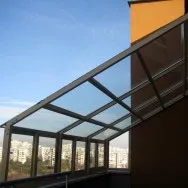
Glass
In its pure form, glass is a transparent, fairly strong and hard material that is essentially inert and biologically inactive, and it can be formed into a very smooth, impervious surface. This is why it has so many uses. Glass is, however, brittle and breaks into sharp pieces. These properties can be changed, partly or completely, by adding other ingredients or by heat treatment.
Glasses are homogeneous amorphous materials, usually made by cooling a suitable molten, viscous material quickly, so that there is no time for an ordered crystal lattice to form. They can be made from many materials. Because glass is strong and non-reactive, many everyday objects are made of it: glasses and bottles, light bulbs, mirrors, monitor and television screens, windows.
Types of glass by production method
Float glass
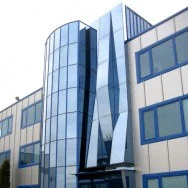
90 % of the flat glass in the world is made with the float glass process, invented by Sir Alastair Pilkington of Pilkington Glass. Molten glass is poured in at one end of a bath of molten tin, flows over the tin and levels out, so that it becomes flat on both sides. It cools slowly and hardens as it moves over the tin, and leaves the bath as a continuous ribbon. It is then polished. The finished product has almost perfectly parallel surfaces.
The standard thicknesses are 2, 3, 4, 5, 6, 8, 10, 12, 15, 19 and 22 mm. Float glass is dangerous in some uses, because it breaks into large jagged pieces that can cause serious injury. Many building codes around the world restrict its use in places with a high risk of breakage and injury: bathrooms, doors, low parts of schools.
Plate glass
Before Pilkington’s invention, flat glass was usually made by extrusion or rolling. The surfaces were not optically parallel and distorted the image; parallel surfaces were achieved by mechanical polishing, which made the product much more expensive.
Cylinder glass
Another popular method before Pilkington: the glass is blown into a hollow cylinder, its ends are cut off and it is split lengthwise, then reheated and unrolled into a flat sheet. This was the first method for flat glass, which is why the panes were small. Other methods were also known before the float process: Fourcault, Pittsburgh, Asahi and others.
Toughened glass
Toughened (tempered) glass is made by heat-treating float glass. The glass is cut to size, and all processing, such as polishing the edges and drilling holes, is done before toughening. It is then heated in a furnace above the tempering point of 600 °C and cooled quickly with air. This creates compressive stresses on the surface, balanced by tensile stresses deeper inside; the cooling pattern can be seen under polarised light.
Toughened glass is usually six times stronger than ordinary glass. It also has drawbacks: because of the internal stresses, any damage to the edge shatters it into small pieces, so it is cut before toughening and cannot be processed afterwards. Its surface is also softer and scratches more easily. It is usually used in frameless elements (frameless doors, for example) and for structural purposes. It is considered less risky than ordinary glass, because it is stronger and breaks into small rounded pieces that are less likely to cause injury.
Laminated glass (triplex)
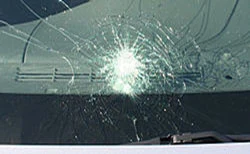
Laminated glass was invented in 1903 by the French chemist Édouard Bénédictus, inspired by an accident: a glass flask that had carelessly been left coated with a layer of cellulose nitrate broke when dropped, but did not fall apart. He created a glass and plastic composite to reduce injuries in car accidents. Car makers did not take it up straight away; its first wide use was in gas masks during the First World War.
Today, laminated glass is made by bonding two or more layers of float glass with a plastic interlayer, usually of polyvinyl butyral (PVB). The panes with PVB between them are heated to about 70 °C and passed through rollers, which push out the air and create the first bond. The typical build-up is 3 mm glass / 0.38 mm interlayer / 3 mm glass, a finished product known as 6.38 laminated glass.
The interlayer holds the two layers of glass together even after breaking, and its high strength stops the glass from shattering into large sharp pieces. More layers and thicker glass make it stronger still; bulletproof glass panels made of thick glass with several interlayers reach 50 mm in thickness. With its damping effect, PVB also improves the sound insulation of the glass, and it blocks 99 % of ultraviolet light. Laminated glass is used where the risk of injury is higher, typically in shop windows and car windows.
Self-cleaning glass
A recent invention, again by Pilkington Glass, for construction, the car industry and other fields. A 50-nanometre coating of titanium oxide on the outer side creates two self-cleaning mechanisms: a photocatalytic effect, in which ultraviolet rays break down the organic compounds on the surface, and a hydrophilic effect, in which water forms a thin layer and washes away the broken-down compounds.
The insulated glazing unit
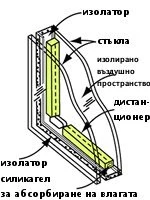
An insulated glazing unit is several sheets of glass joined with sealant (adhesive) and a spacer. Between the panes there is a hermetically sealed space that polluted air cannot get into. This is why the unit lasts for many years and gives better thermal and sound insulation and wind resistance. How well it insulates depends on the type of glass, its thickness and the distance between the panes. The required values are easier to reach with special glass that has a low-emissivity coating.
Low-E (K) glass or high-performance “4 Seasons” glass
Over the last year or two, high-performance glass, also called “all-season”, “energy” or simply “4 Seasons”, has become more and more common. Like low-emissivity glass, it has a metallic coating on one side, but it is a further development of K glass with better values, especially in summer.
Low-E (K) glass lets more solar heat through from outside to inside than from inside to outside. In winter this is an advantage: more heat stays in the room. In summer it turns into a drawback: a greenhouse effect builds up and more energy is needed for cooling. High-performance “4 Seasons” glass avoids this effect and works equally well in both directions in all seasons, hence the name.
Like K glass, “4 Seasons” glass goes into a glazing unit together with one clear (ordinary) pane, with a total thickness of 24 mm. Its values are better than those of the 24 mm clear/K combination, which is already a standard legal requirement in Bulgaria, mainly because they are equally good in all seasons, and less because of the thermal insulation coefficient. It is also available 6 mm thick, in a unit with 4 mm clear glass, when better noise insulation is wanted.
Site visit, measuring, offer
Call or write to us: a specialist comes to see the site, takes the measurements and helps you choose.